I’ve been sitting with something really disconcerting lately.
In nearly every organization I work with across industries, roles, and seniority levels, I hear some version of the same undercurrent of truth:
“I care deeply about my people and my work. I just don’t know how to hold everything that’s being asked of me.”
Managers are tired. Not disengaged. Not resistant. Just tired. And I get it…
They’re carrying pressure from above, emotion from below, and constant change all around them, often without space to process any of it. And we’ve somehow normalized this as “the cost of leadership.”
But here’s what I want to say out loud, gently and clearly:
Most managers are not failing. They are under-supported.

Today’s managers are navigating far more than performance and deadlines.
They’re holding:
Team anxiety during ongoing change
Hybrid dynamics that strain connection
Unclear expectations in fast-moving systems
Emotional labor they were never trained for
And now, the accelerating presence of AI and automation
None of this is theoretical. It’s their lived experience. Mine, too…
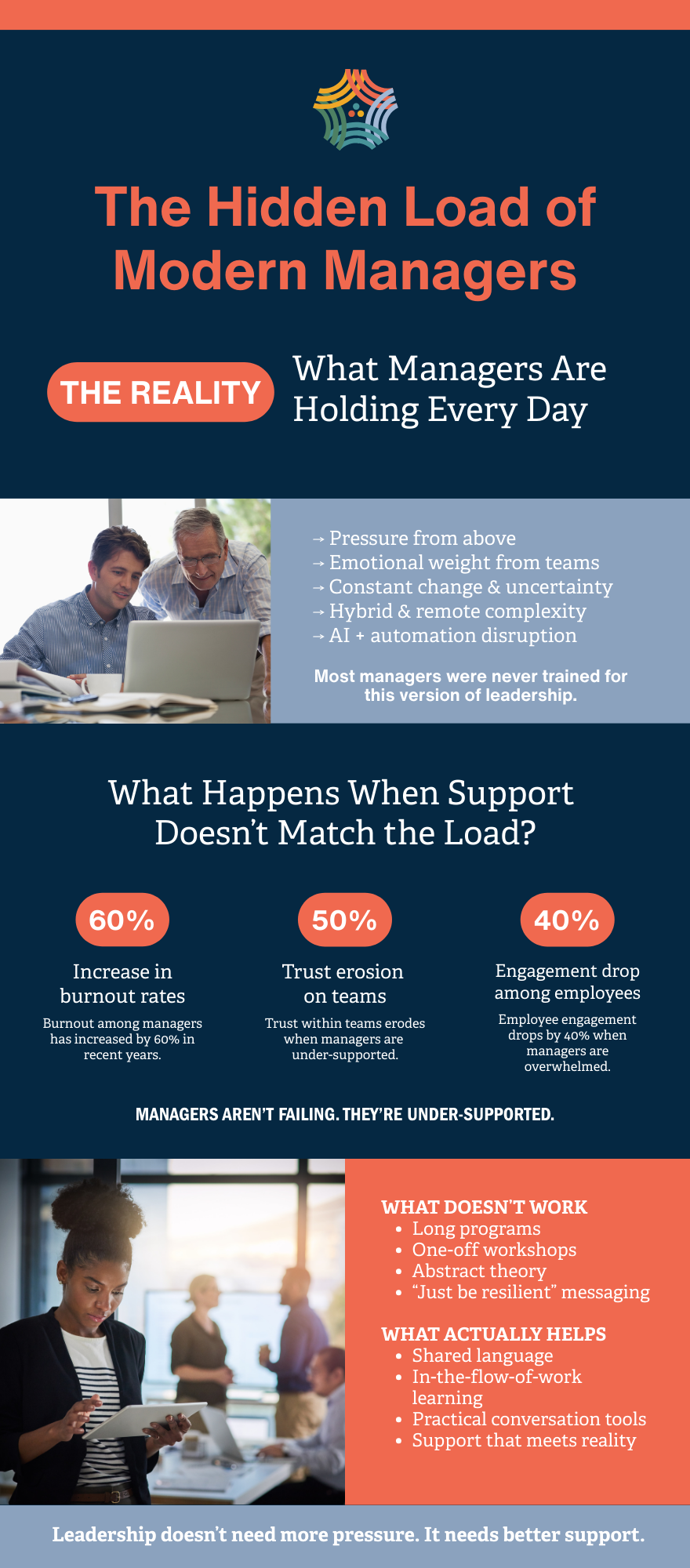
Recent research backs this up. Gallup’s 2023 State of the Global Workplace report found that managers experience higher levels of burnout than individual contributors, largely due to role strain and lack of support. Gallup also continues to show that managers account for up to 70% of the variance in team engagement, which means we’re placing enormous responsibility on people who often feel like they’re barely keeping their footing.
That’s not a character issue. That’s a systems issue.

Here’s where many organizations get stuck.
When things feel strained, the instinct is to add:
Another program
Another framework
Another initiative layered onto already full plates
But more tools and more programs aren’t what managers are missing.
What they’re missing is practical support that meets them where they are…inside real conversations, real tension, real uncertainty.
We’ve known for years that leadership doesn’t change through one-off workshops. Google’s Project Aristotle made that clear back in 2015, identifying psychological safety as the single most important factor on effective teams. That insight hasn’t aged; it’s become more relevant.
And yet, many managers are still expected to create psychological safety without ever being shown how it actually looks and sounds in everyday moments.

Add AI into the mix, and the pace only increases.
Microsoft’s 2024 Work Trend Index reports that over 60% of employees feel they lack the time and energy to do their work, even as organizations adopt tools meant to improve efficiency. Speed is increasing, but clarity isn’t keeping up.
When leaders move faster than trust can form, people retreat. They comply instead of contribute. They disengage quietly. And this can spell disaster…I’ve seen it time and time again.
Managers feel this first.
They’re the ones absorbing confusion, translating decisions, smoothing friction, and holding morale, often without language, tools, or permission to slow things down long enough to reconnect.

When I listen closely to managers (not in surveys, but in real conversations) I hear something simple and deeply human:
“Help me have harder conversations without damaging relationships.”
“Help me lead change without pretending I’m more certain than I am.”
“Help me support my people without burning myself out.”
This isn’t about becoming a “better version” of themselves. It’s about becoming more grounded versions.
More honest. More present. More supported.

What if leadership development wasn’t about fixing managers?
What if it was about standing with them?
Giving them language for what they’re already sensing. Normalizing the strain they’re under. Helping them build habits that stabilize teams, not by doing more, but by doing what matters most.
Trust.
Clarity.
Repair.
Consistency.
Human connection.
These aren’t soft skills. They’re survival skills for modern work. And we simply cannot overlook them…

If you’re a manager reading this and thinking, “Yes. This is exactly it,” I want you to know something:
You’re not behind. You’re not broken. You’re responding normally to an abnormal amount of pressure.
And if you’re someone who supports managers—HR, L&D, senior leadership—I’ll offer this gently:
The most generous thing we can do right now is stop pretending that leadership is easy if someone is “good enough.”
It isn’t. And it never has been.
But with the right support, it can become more humane. More sustainable. More honest.
That’s the work I believe in. And it starts by telling the truth…together.